Contact all five offices
Each one can move BPCA in a different way, so send all five, then sign the petition. About two minutes in total.
Step 1NEWMessage Governor Hochul
She appoints the BPCA board, and hers is the only office that can order a pause. Her office takes no email: copy the message, then paste it into her form. Or call, which takes about sixty seconds.
Her form has its own Subject box: copy the subject
Calls are logged the same way written messages are. Show the 60-second phone script →
60-second phone scriptHi, my name is [your name], and I'm a Battery Park City resident. I'm calling about the Battery Park City Authority's North/West Resiliency project — they're removing 502 mature trees, more than 40% of every tree in the project area and roughly 80% on the South Esplanade. They say the cutting is needed for FEMA certification, but FEMA has said in writing it doesn't require a tree-free zone. I'm asking the Governor to direct BPCA to pause removals in any reach not already under construction, and to order an independent, tree-by-tree review before any more come down. Thank you for your time.
Read the message first
The message to the Governor
Why this needs a second look
- A loss this big can't be undone. 502 mature trees, about 40% of the waterfront canopy and ~80% of the South Esplanade.[7] Once a 40-year-old tree is cut, it's gone; replacements take 20–30 years to catch up. For any decision this big and this permanent, you'd get a second opinion. These trees deserve one before more come down. See the math →
- BPCA points to FEMA to justify the cutting. FEMA says it doesn't require it. BPCA says the tree clearance is part of getting the floodwall certified by FEMA, which it says "routinely relies on" Army Corps guidance calling for a 15-foot tree-free zone. Asked directly, FEMA answered in writing that it "does not impose a fixed vegetation-free zone requirement." The 15-foot rule →
You might be thinking…
- “But they’re planting more trees than they cut.” 525 new trees for 502 — but the count isn’t the point, the size is. 93% of BPC’s trees today are already bigger than the smaller replants, and a 3-inch replant needs roughly 30 years to catch up. See the sizes →
Read the full case
1. The scale alone demands it.
Removing about 80% of the South Esplanade's mature trees — and 40% of the waterfront's overall[7] — is drastic on its face. A loss that size warrants independent, tree-by-tree verification regardless of the reason behind it.
2. The one reason that can be checked doesn't hold up.
The clearest sign the cutting goes further than necessary is the 15-foot tree-free buffer, which BPCA ties to FEMA certification of the floodwall. It is the one stated rationale the Authority anchored to an outside standard, and held to those authorities, BPCA's case for applying it as a blanket comes apart: FEMA doesn't require it, and the USACE guidance it traces to isn't binding here — BPCA itself says this “is not a USACE project.” Even where that guidance does apply, it carries a variance process for keeping trees where engineering allows, and federal law bars even the Army Corps from forcing the removal of existing trees without showing, tree by tree, an unacceptable risk.
FEMA has now answered — in writing. Asked directly whether the buffer is required, FEMA Region 2's MT-2 map-revision coordinator replied that "FEMA does not impose a fixed vegetation-free zone requirement as part of 44 CFR §65.10." The clearance is the certifying engineer’s judgment, not a FEMA mandate — the wall can be certified and the flood maps revised without the blanket buffer. And BPCA's own Final EIS shows the 15 feet was never fixed: it describes the rule the project started from as "a conservative interpretation of USACE guidelines for flood walls" (ES-17), and the final plan places new trees between 10 and 15 feet from the barrier in locations judged one by one on wave exposure, elevation and distance to the gates. BPCA relaxed the rule where it meant planting trees back. It never revisited it for the trees already standing — removals went from 420 in the Draft EIS to 435 in the Final, and 502 today.
So the toll isn't fixed by an outside rule. A design that judges each tree on its own — and removes only those that genuinely can't be kept — can satisfy FEMA and save far more of the canopy.
What we're asking BPCA to do
Two steps to show every removal is truly necessary — before any more trees are cut.
-
1
A retention-first, tree-by-tree review.
What this means
Judge each of the 502 trees individually for whether it can be kept — instead of applying a blanket 15-foot clear zone. For every tree marked for removal, publish the specific design constraint that made retention impossible; where that constraint is itself a design choice (alignment, limits of work, foundation type, buffer assumption), publish the alternative considered and the basis for rejecting it.
-
2
An independent second opinion.
What this means
A genuine outside review — by qualified arborists, flood engineers, and landscape architects with no financial relationship to Turner, the design-build contractor that prepared the current plan — with its findings published on the public record.
No further removals in any reach until the analyses for that reach have been published and independently reviewed.
Communities have stopped this before
Sacramento, 2025 — Army Corps planned to cut 700+ trees for levee work. A federal judge halted all cutting while the court decides whether the Corps skipped the tree-saving alternative it had promised to study.
Coeur d'Alene, 2012 — Army Corps ordered 1,000+ mature pines removed from a levee. The community fought back, and only the dead and unhealthy trees came down — roughly 640 mature pines were saved.
Read all the stories →
Go deeper
How we got here — the public record so far
FEIS — May 2025. 435 mature trees marked for removal, 450 to be planted. BPCA classified the project as "no significant adverse impact."
[1]
Technical Memorandum — Dec 19, 2025. Removal count revised from 435 to 500 (+65 — including 50 along the Route 9A median, +15 in Reach 6, +5 in Reach 3, with South Cove falling from 35 to 30). No Supplemental EIS prepared.
[14]
BPCA's response to community inquiries — May 2026. Confirmed the 500 figure, stated USACE doesn't directly apply, did not publish the per-tree reasoning. Full text in the next section.
[13]
BPCA's response to community inquiries — Michael Ryan, Community Construction Liaison
Good afternoon resident,
Thank you for writing, and for your support of the North/West Battery Park City Resiliency Project (NWBPCR). The vital work now underway will protect our neighborhood against the threat of storm surge and flooding resulting from heavy rains and sea level rise. Nearly 14 years since Superstorm Sandy claimed 44 lives, including one here in Lower Manhattan, and after five years of community input on project design across dozens of public engagement sessions, we’re glad to be delivering a more resilient downtown with our part of New York City’s overall Lower Manhattan Coastal Resiliency Project. As to your specific concerns here, we’re glad to note that NWBPCR will result in a net increase in the number of trees in Battery Park City.
Battery Park City has more than 1,700 total trees across its 92-acre site. As we have articulated over the course of our public engagement, it is, unfortunately, necessary to remove some of these trees to effectuate building of the NWBPCR flood barrier system (FBS). Additionally – and unrelated to the Authority’s resiliency work – a number of trees require removal due to poor health.
The project team has worked diligently to minimize tree removals to the greatest extent possible, and our approach for the planting of new ones will prioritize diversity in species, age, and size to cultivate a more sustainable urban tree canopy.
More detailed information regarding tree removal is reflected in the bullets below. Following that are some more specific answers to your questions.
The NWBPCR Final Environmental Impact Statement (FEIS) contemplated a net increase in the number of trees pre vs. post construction – a total of 435 existing trees to be removed and 450 new trees to be planted – a +15 net increase.
40 of these tree removals are “conditions” removals – meaning trees in poor health that would have required removal even without any resiliency work occurring.
In its post-FEIS Technical Memorandum (December 2025), the Authority noted an increase in the estimated number of trees requiring removal with a corresponding increase in the estimated number of new trees to be planted. The result was a greater net increase in new trees planted – a total of 500 existing trees removed (+65 from FEIS) with 525 new trees planted (+75 from FEIS) – a +25 net increase.
The majority of the increase of removals that were noted in the 12/25 Tech Memo – 50 of 65 trees – are located outside Battery Park City, along the Route 9A median.
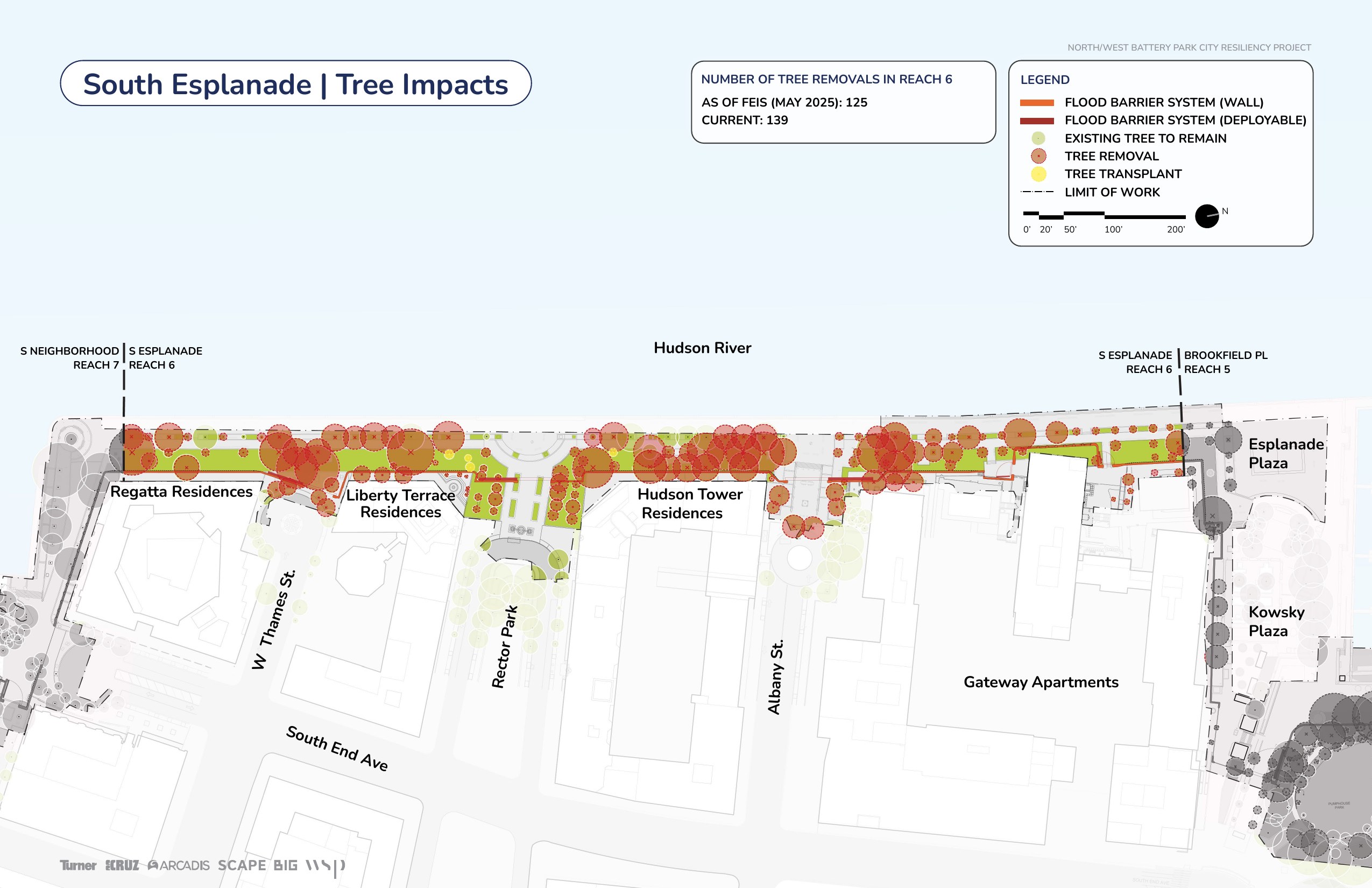
The balance, mostly in Reach 6 (South Esplanade), are required to be removed to accommodate a combination of FDNY ambulance access, hydrant removal/installation, utilities conflicts, or grading/draining requirements.
The Tech Memo also noted that in the South Cove area of the project, where construction work recently began, five fewer trees (30) would require removal than the 35 contemplated in the FEIS.
Has each tree been individually assessed? How many of the 435 actually fall within the required clearance zone? Which could remain with modified wall alignments?
Each tree in the project area was assessed for removal, protection, or transplantation.
What design alternatives were evaluated for tree-adjacent sections? The project already uses deployable barriers at multiple locations — were similar approaches considered where they could preserve mature trees?
The alternatives analyzed are set forth in the Alternatives Chapter of the FEIS. NWBPCR has been designed to minimize tree clearing to the extent possible. As a general matter, trees have been designated for removal due to construction either because they are located within the limits of work or because they are sufficiently close to such areas that the root zones of the trees would be impacted. It is instructive to note here that, in comparison to typical wall construction, the flood barrier system (FBS) includes substantial underground elements, including drilled pile foundations and seepage barriers that extend below the surface.
To protect the structural integrity and function of the FBS from detrimental effects of vegetation (for example, root intrusion, falling limbs or trees, or blocking inspection and maintenance access) all trees must be kept at a minimum distance from the system’s wall and gates. This distance is determined through careful analysis of the system’s vulnerability such as the type of foundation used, proximity to operable/deployable elements, exposure to wave impact, and elevation at each site – as well as the species and size of the proposed trees, their growth habits, and their tolerance to flooding, wind, and salt exposure. This analysis will also be part of the overall process for flood protection certification.
Has BPCA explored the USACE Vegetation Variance Request process? Federal guidelines include a formal mechanism for preserving vegetation when site-specific analysis supports it. Has this been pursued? If not, why not?
The US Army Corps of Engineers Guidelines are not directly applicable to NWBPCR because it is not a USACE project, so no variance has been or needs to be sought. As discussed in the FEIS, 60 replacement trees will be planted within the 15-foot USACE “buffer” zone as part of the project.
Has BPCA considered transplanting trees that must be removed during construction and returning them afterward? Other US cities have done this successfully — Phoenix's Central Station redevelopment relocated 20 mature trees during construction, and Stanford's Packard Children's Hospital boxed and stored 12 protected oaks and redwoods for replanting. If transplanting has not been evaluated, why not?
Tree transplantation has been considered, and a total of 7 trees within the project site identified will be transplanted. Considerations that impact tree suitability for transplant include: Species, Size (smaller is better, larger trees are harder and more expensive to transplant and are less likely to survive the process), Overall tree health, Suitable location to be transplanted to.
How does removing 40-year-old canopy — and replacing it with saplings that won’t match its stormwater, cooling, and carbon benefits for decades — serve a project whose purpose is resilience?
NWBPCR will provide for a diversity in tree age at the time of planting. Approximately one-third of the trees proposed to be replanted along the Esplanade and throughout Battery Park City will range from 4- to 8-in trunk caliper, which means that these trees will be several years old at the time of planting (i.e., not young saplings). The balance will be 3-in caliper or are multitrunk species and thus are not measured by trunk diameter, but rather by height, which is anticipated to be 8ft to 14ft at time of planting. Tree purchases will be timed to allow for uninterrupted growth in nurseries before planting occurs.
Thank you again for writing, and for your support of our coastal resiliency work. For regular updates please subscribe to our biweekly construction newsletter, and please send any project-related questions to: nwbpcrinfo@bpca.ny.gov or (917) 436-6739.
Sincerely,
Michael
Michael Ryan
Community Construction Liaison
Sources
- BPCA Final EIS — Response to Comments (May 2025) — Table 10-1: 435 trees removed, 450 planted, per-reach breakdown; ~395 due to construction, ~40 due to health; deployable barrier locations; USACE vegetation policy discussion
- BPCA Final EIS — Chapter 3.5 Natural Resources (May 2025) — tree inventory (1,181 trees, 69 species); impact assessment; "no significant adverse impact" determination
- The Broadsheet — "Going to the Wall" — BPCA cites USACE 15-ft vegetation-free zone
- USACE EP 1110-2-18 — Guidelines for Landscape Planting and Vegetation Management at Levees, Floodwalls, Embankment Dams, and Appurtenant Structures (May 2019) — Section 2-2: vegetation-free zone primary purpose is access; Section 1-2(b): variance process for preserving natural resources; Section 3-3: floodwall-specific provisions
- Battery Alliance v. BPCA — Petitioners' Memorandum of Law (Nov 2025) — confirms BPCA never applied for vegetation variance (p. 8); pending in NY Supreme Court, Index No. 162911/2025
- BPCA Final EIS — Executive Summary (May 2025) — ES-17/18: tree removal and replacement summary; design "meets the objectives of FEMA (and the USACE guidelines)"; DEIS commitment to explore FEMA variance process struck from Final EIS
- BPCA — N/WBPCR Project Tree Impacts Map (May 2026) — updated per-reach tree impact maps with side-by-side FEIS (May 2025) and CURRENT counts; published on bpcresiliency.info /construction-updates
- BPCA Environmental Review page — full DEIS/FEIS chapter index and appendices
- Battery Alliance (savebpc.org) — community campaign and pending lawsuit
- Downtown Magazine — "Fortress or Neighborhood?" — resident concerns about the project
- Sen. Kavanagh letter to BPCA — elected officials raised concerns about the South BPC resilience project
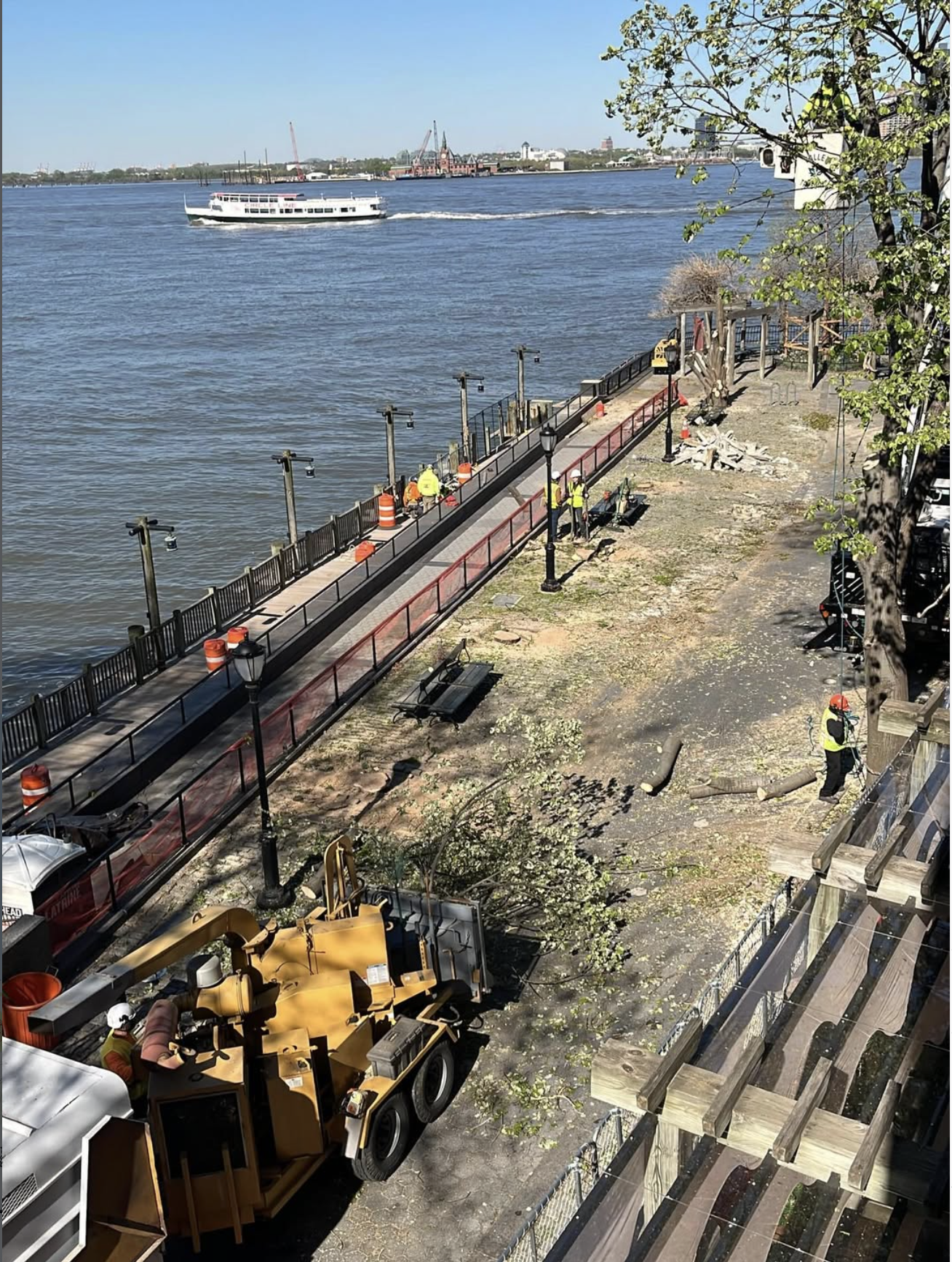
- @treesbpc on Instagram — community documentation of tree removals already underway in south Battery Park
- BPCA response to community inquiries (Michael Ryan, Community Construction Liaison, May 2026) — full text in the "BPCA's response to community inquiries" accordion above
- BPCA NWBPCR Technical Memorandum (December 19, 2025) — Sections B.2 and D address the 435 → 500 tree-removal increase and the no-Supplemental-EIS conclusion