Battery Park City Waterfront — Tree Removal: Request for an Independent Review
Fact sheet — request for an independent review. Every claim is linked to its primary source.
At a glance
- Scale. BPCA’s current tree map (May 14, 2026) marks 502 mature trees for removal, up from 435 in the Final EIS. That is more than 40% of the 1,181 trees BPCA inventoried in the project area, and 139 trees, about 80%, of the South Esplanade.
- The map. BPCA’s own tree-impacts map (PDF), reach by reach — South Esplanade on page 17. Every reach’s plan image: Which trees will be cut? →
- What FEMA said. BPCA ties the 15-foot tree-free buffer to getting the wall FEMA-accredited. FEMA Region 2, in writing (June 18, 2026): “FEMA does not impose a fixed vegetation-free zone requirement as part of 44 CFR §65.10,” and, on what vegetation standard applies to a floodwall like this one, “There are no vegetation standards. Whatever they certify as appropriate.” Details ↓
- Who can pause the removals. BPCA’s board. The Governor appoints its members and is the lever on the board. Details ↓
- “But they’re planting more than they cut.” 525 new trees for 502 — but 93% of BPC’s trees today are bigger than the smaller replants, and a 3-inch replant takes roughly 30 years to catch up. Details ↓
- The ask. An independent second opinion — from someone not tied to the design contractor (Turner) — and a tree-by-tree review, before any more trees come down.
The claim
The current design loses more mature trees than necessary — 40% of the waterfront's mature trees, and 80% in the South Esplanade alone. That toll is too big to take on trust — a loss that scale demands proof it's truly unavoidable, tree by tree.
The clearest sign that the cutting goes further than necessary is the 15-foot vegetation-free buffer. BPCA has cited it as a reason for removals since 2022 and still invokes it today — restated as "best practice" in its May 2026 emails — while the removal count has only risen, never fallen. The blanket is still in force. It isn't the only reason trees are coming down, but it's the one that can be checked most directly against an outside authority.
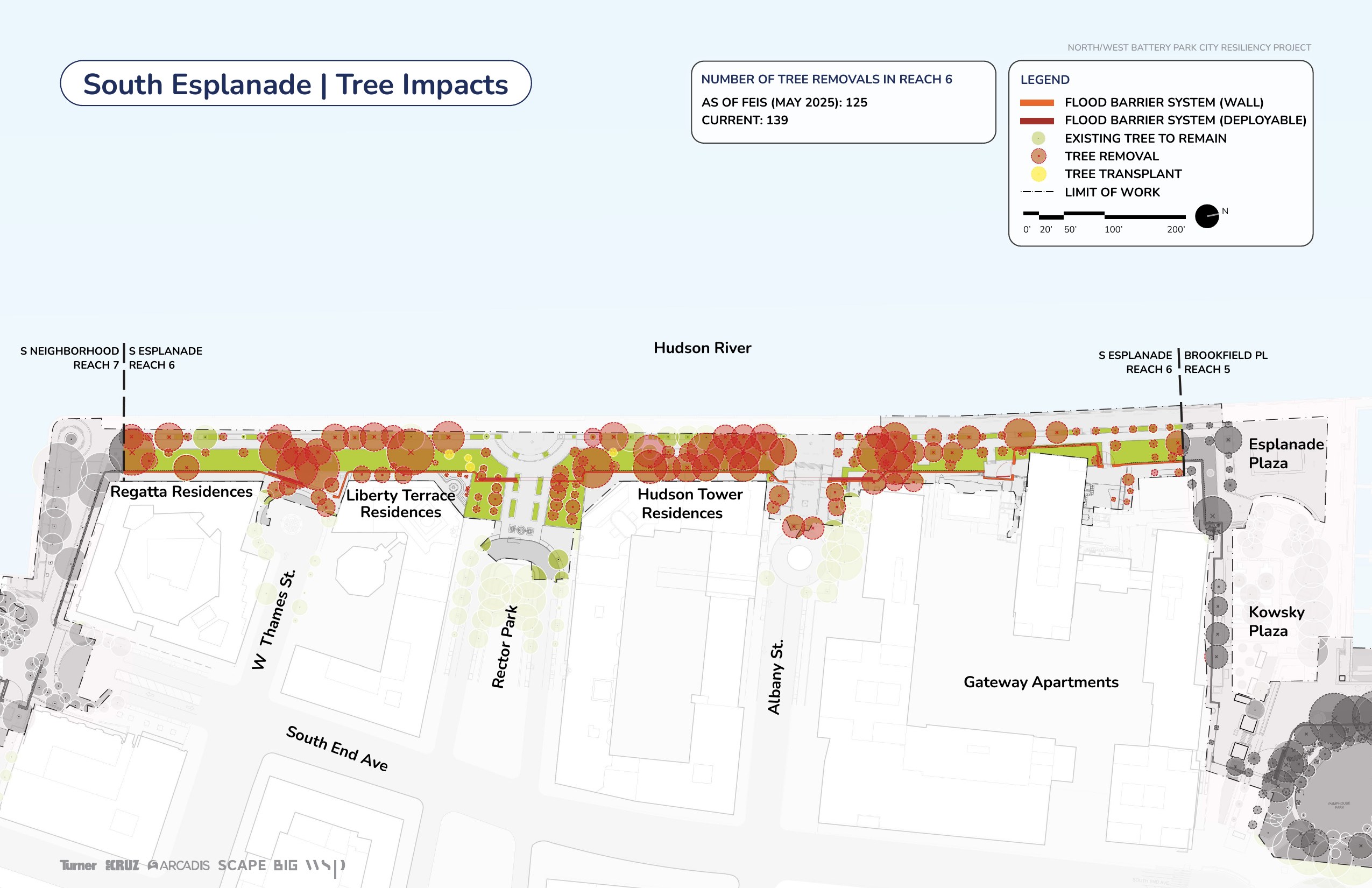
Why an independent second look at the trees is warranted
Two things, together, make a second opinion necessary before any more trees come down:
- The scale. Removing 80% of a stretch's mature trees is drastic on its face — a number that large warrants independent verification regardless of the reason behind it.
- The inconsistency in why the trees must go. BPCA's stated reason for the 15-foot vegetation-free buffer doesn't hold up: held to the two authorities BPCA points to, it fails at both. FEMA — the agency the reason keeps returning to — doesn't require it. And USACE — the floodwall experts whose guideline the buffer traces to — is barred by law from forcing it as a blanket on existing trees, and provides a formal process to reduce it.
A loss this size — 40% of the waterfront, 80% of the South Esplanade — warrants checking each tree on its own. And on top of that, the one rationale that could be checked doesn't hold against its own authorities.
“But they’re planting more trees than they cut”
BPCA plans 525 new trees for the 502 it removes. The count isn’t the point — the size is. In BPCA’s own words, about one-third of the replacements will have 4- to 8-inch trunks, and “the balance will be 3-in caliper” or multi-trunk trees “8ft to 14ft at time of planting” (BPCA construction update, May 2026). BPCA’s own tree inventory shows 93% of BPC’s measured trees are already bigger than the smaller replants (1,646 of 1,769). At NYC growth rates, a 3-inch replant needs roughly 30 years to reach the size of an average BPC tree today. The sizes, with photos →
The ask
A genuine second opinion on the design — by someone not tied to the design contractor (Turner) — before any more trees come down, including a tree-by-tree review: each tree judged individually for whether it can be kept, instead of a blanket clear zone.
The ask isn't to break a rule or stop the wall. BPCA's own FEIS describes the 15-foot rule it started from as "a conservative interpretation of USACE guidelines for flood walls" (ES-17) — and it has already relaxed that interpretation once, for new plantings, evaluating the distance location by location. The ask is to do the same for the trees already standing: judge each on its own, and have someone independent confirm that those still marked for removal genuinely can't be saved.
Who can pause the removals
BPCA’s board can. State law gives the Authority itself the power “to acquire, construct, improve, enlarge, operate and maintain a project” and “to make contracts” (Public Authorities Law §1974). Its seven-member board elects the President, who runs “the initiation, planning and carrying out of the projects” day to day, “in accordance with the rules and policies adopted by the Members” (BPCA bylaws, Art. II).
The Governor is the lever on the board. All seven members are “appointed by the governor with the advice and consent of the senate,” and the Governor may remove a member for “inefficiency, neglect of duty or misconduct in office” after notice and a hearing (§1973). BPCA’s statute gives the Governor no veto over board decisions, so the Governor’s influence works through the people on the board.
Legislators and oversight bodies can press, not order. The State Senate confirms board members. The Authorities Budget Office can investigate, “publicly warn and censure,” and recommend removal of directors (§6) — but none of these can halt the work themselves. Outside BPCA, the remaining route is a legal challenge in court.
The inconsistency in why the trees must go
The inconsistency is the gap between what BPCA says the buffer is for and the facts.
What BPCA says the buffer is for
BPCA's stated reason the buffer is necessary is to protect the wall from nearby vegetation: trees overturning; roots causing foundation damage and seepage; drainage obstructions; animal burrows; and operations-and-maintenance access (BPCA written response to residents, May 18 2026 — on file).
That risk list is itself a tell: it's lifted almost verbatim from USACE's generic national pamphlet for levees, dams, and floodwalls (EP 1110-2-18 §3-1.b) — it even includes "animal burrow harborage," a risk for earthen levee embankments, not an exposed concrete wall. It reads like a copied checklist — not an assessment of BPC's actual trees and wall.
And the way BPCA invokes that authority softened at every step — from a flat FEMA requirement to a vague FEMA reliance, but always still pointing at FEMA:
- FAQ (Dec 2022 & May 2023): "FEMA generally requires a permanent 15-foot distance… for operations and maintenance." — a flat FEMA requirement, and the only time they say "requires."
- DEIS (Aug 2024): USACE guidance "accepted by FEMA as part of the… accreditation process," plus a commitment that BPCA would "continue to review… where it may be acceptable to FEMA through its variance procedures to plant trees." — still FEMA-tied, but with a way out.
- FEIS (May 2025): that entire passage is struck from the document and replaced with something softer — the DEIS's no-planting assumption recast as "a conservative interpretation of USACE guidelines," the FEMA-tie and the variance commitment gone. — no longer a FEMA mandate.
- Emails (May 2026): FEMA "routinely relies on USACE guidance… the certifying engineer must consider [it] in certifying the design." — reliance on guidance, no 15-ft requirement at all (BPCA written response, May 18 2026 — on file).
And the cutting never relented. Across those same years, as BPCA's wording moved from "FEMA requires it" to "FEMA routinely relies on USACE guidance," the number of trees marked for removal rose — from 435 in the FEIS to an estimated 500 in BPCA's own December 2025 technical memorandum, logged as "design refinements," which concluded there would be "no significant adverse environmental impacts not addressed or inadequately addressed in the FEIS" — so no Supplemental EIS was prepared. (BPCA's current tree map, dated May 14 2026, now marks 502.)
The facts
1 — It isn't required — not by FEMA, and USACE doesn't bind BPCA.
The buffer is presented as part of what gets the wall FEMA-accredited. That isn't true. FEMA Region 2's MT-2 Revision Coordinator, in a written reply to a pre-submittal inquiry through FEMA's Mapping & Insurance eXchange (June 18, 2026 — on file), said so directly: "FEMA does not impose a fixed vegetation-free zone requirement as part of 44 CFR §65.10." Asked what vegetation standard applies to a floodwall like this one, FEMA answered: "There are no vegetation standards. Whatever they certify as appropriate." The clearance is the engineer's call, not a FEMA mandate — and the wall can be FEMA-accredited without the blanket buffer.
And the other authority BPCA points to — USACE — doesn't bind it either, as BPCA itself acknowledges: "USACE guidelines are not directly applicable to NWBPCR because NWBPCR it is not a USACE project. Therefore, no USACE variance has been, or needs to be, sought." (BPCA written response, May 18 2026 — on file). The USACE regime is a persuasive federal benchmark here, not a legal obligation on BPCA.
2 — Even where USACE guidance is followed, it has an exception process, and federal law bars USACE from forcing the buffer as a blanket removal of existing trees.
- Site-specific reduction is built into the rule. The 15 feet is a minimum a formal variance can reduce — "the minimum vegetation-free zone dimensions may not be diminished without a formal variance" (EP 1110-2-18 ¶2-2.d, variance route at ¶1-3.b), and USACE published the process to do it (Feb 2012; 77 Fed. Reg. 9637). Federal law goes further: a USACE variance "may include a complete exemption to guidelines, if appropriate" (WRRDA 2014 §3013(c)(2)(B)).
- Federal law bars forced removal of existing trees absent individualized proof. WRRDA 2014 §3013(g): the Secretary of the Army "shall not require the removal of existing vegetation… unless the specific vegetation has been demonstrated to present an unacceptable safety risk" — individualized to the specific tree, not categorical. Even Congress told the federal levee agency it may not force removal of existing trees without proving a specific, unacceptable risk — yet BPCA is doing voluntarily, and in full, what USACE itself is barred from forcing.
3 — The reasons for the buffer don't fit this wall — and BPCA never showed they do.
- Access is a remote-levee idea. USACE's primary purpose for the 15 feet is an access corridor for flood-fighting — sized for "tractors, bulldozers, dump trucks, and helicopters." This is a Manhattan esplanade: a paved promenade already runs the wall's length, and the flood-fight is closing deployable gates, not staging heavy equipment.
- The structural concern is weight-dependent — and was never checked here. USACE names three ways roots damage a floodwall: jacking, joint intrusion, clogged toe drains. On the first it qualifies itself — "Smaller (lighter) floodwalls are more susceptible than larger (heavier) structures" (EP 1110-2-18 ¶3-3.b(2)(a)). BPCA's own cross-sections (FEIS Fig. 1-17h/i) show a footed concrete wall on piles driven into a platform — not the light sheet-pile wall that qualifier points at. And for overturning, USACE offers four controls "alone or in combination" — distance, species selection, monitoring, intervening obstacles — with distance governing only "where other factors are unreliable" (¶3-3.b(1)). BPCA used distance, everywhere, without showing on the record that it tested any of these against this structure or any individual tree.
- One reason gives the copy away. BPCA's own risk list includes "animal burrow harborage" (BPCA written response to residents, May 18 2026 — on file) — tracking USACE's reason to "limit those habitat characteristics that encourage the creation of animal burrows" (EP 1110-2-18 ¶3-1.b(4)), a failure mode of earthen embankments. There is no embankment here to burrow through; the wall stands on piles over water.
USACE's own 2024 draft revision of this guidance (joint with FEMA, released for comment and not yet final) moves further in the same direction: "A risk-informed approach for managing vegetation on or near levee systems should be applied," with decisions made "on a case-by-case basis" and, for established legacy trees, a risk assessment before removal. It also offers a floodwall-compatible option BPCA never evaluated — root-containing planting boxes at the wall, with New York's own High Line named as the model.
And by BPCA's own word, the buffer is a conservative reading — one it has already relaxed, but only in the direction that costs no trees. The FEIS describes the rule BPCA started from as "a conservative interpretation of USACE guidelines for flood walls" (ES-17). Between the Draft and Final EIS, BPCA revisited that interpretation — and relaxed it in one direction only. For new plantings, it stopped treating 15 feet as absolute: the Final EIS places replacement trees "between 10 and 15 feet from the flood barrier system in specific locations," each evaluated against wave impact, elevation, and proximity to gates. For existing trees, nothing was revisited: removals rose from 420 in the Draft EIS to 435 in the Final, and to 502 today. The same authority, read two ways — flexible and site-specific where it means planting trees back, absolute where it means keeping the ones already standing. BPCA has already shown it can evaluate the distance tree by tree. It has simply never done it for the trees it is cutting.
Why it's achievable, not either/or
Keeping the wall and keeping the trees aren't in conflict. FEMA's flood-map compliance rests on the certifying engineer's judgment, not a 15-foot clear zone — and federal law bars even USACE from forcing a blanket removal of existing trees, with a formal exception process to reduce the clearance. So a design that judges each tree on its own and removes only those that genuinely can't be kept can satisfy FEMA and preserve far more of the canopy.
Questions, or want the FEMA reply and BPCA’s emails that are cited as “on file”? Write to the resident campaign:
Sources
Scale of removal
- BPCA Tree Impacts Map (dated May 14 2026) — per-reach removal counts (435 at FEIS → 502 current); the South Esplanade (Reach 6) sheet is on page 17. https://www.bpcresiliency.info/_files/ugd/d993df_4ab097200c4248479f88414fc7892dab.pdf (portal: https://www.bpcresiliency.info/construction-updates#treeimpacts )
- BPCA FEIS, Ch. 3.5 Natural Resources, p. 3.5-18 (PDF p22) — "a tree inventory conducted in the Study Area… identified 1,181 trees comprising 69 species": the total-tree count behind the 40% (502 of 1,181 ≈ 43%). https://media.bpca.ny.gov/wp-content/uploads/2025/05/19113032/3.5_Natural-Resources.pdf#page=22
- BPCA public tree inventory (TreePlotter) — ~173 trees along the South Esplanade (the 80% denominator). https://pg-cloud.com/BPCA/
The rising count / "design refinements"
- BPCA Post-FEIS Technical Memorandum, Dec 19 2025 — 435 → an estimated 500 removals attributed to "design refinements" (§A, §D); concludes "no significant adverse environmental impacts not addressed or inadequately addressed in the FEIS," so no Supplemental EIS. https://media.bpca.ny.gov/wp-content/uploads/2026/04/28161623/BPCA-Post-FEIS-Tech-Memo-12.19.25.pdf
- BPCA DEIS (Aug 2024), Executive Summary (PDF p16) — "an estimated 420 trees need to be cleared with 390 new tree plantings and 17 tree transplants": the Draft-EIS baseline the Final EIS raised to 435/450. https://media.bpca.ny.gov/wp-content/uploads/2024/08/28173649/0.0_Executive-Summary.pdf#page=16
BPCA's stated rationale & its shifting FEMA framing
- BPCA FAQ (updated May 2023), Q24 (PDF p8) — "FEMA generally requires a permanent 15-foot distance." https://media.bpca.ny.gov/wp-content/uploads/2023/05/16122544/NWBPCR-FAQs_Updated-MAY-2023.pdf#page=8
- BPCA DEIS (Aug 2024), Executive Summary (PDF p16) — original passage: USACE guidance "accepted by FEMA as part of the flood protection system accreditation process," a "15 foot (minimum) clear zone… is to be provided," and a commitment that BPCA would "continue to review… where it may be acceptable to FEMA through its variance procedures to plant trees." https://media.bpca.ny.gov/wp-content/uploads/2024/08/28173649/0.0_Executive-Summary.pdf#page=16
- BPCA FEIS (May 2025), Executive Summary (PDF p19, printed ES-17/18) — the entire DEIS passage above appears struck; replaced by the DEIS's no-planting assumption recast as "a conservative interpretation of USACE guidelines for flood walls." https://media.bpca.ny.gov/wp-content/uploads/2025/05/19140230/0.0_Executive-Summary_05.19.pdf#page=19
- BPCA written responses to residents, May 6 & May 18 2026 (on file, available on request) — full vegetation-risk list; "Mindful of USACE guidance for best practice in FBS construction" (May 18); "FEMA… routinely relies on USACE guidance… the certifying engineer must consider [it] in certifying the design"; "USACE guidelines are not directly applicable to NWBPCR because NWBPCR it is not a USACE project. Therefore, no USACE variance has been, or needs to be, sought."
FEMA
- FEMA Region 2 MT-2 Revision Coordinator — written reply to a pre-submittal inquiry via FEMA's Mapping & Insurance eXchange (FMIX), June 18 2026 (on file, available on request): "FEMA does not impose a fixed vegetation-free zone requirement as part of 44 CFR §65.10."; on EM 1110-2-583, "Just as guidance."; on what vegetation standard applies to a non-federal floodwall, "There are no vegetation standards. Whatever they certify as appropriate."
- 44 CFR §65.10 — levee accreditation criteria; contains no vegetation-free-zone standard. https://www.ecfr.gov/current/title-44/chapter-I/subchapter-B/part-65/section-65.10
USACE guidance & the wall's actual structure
- USACE EP 1110-2-18 (May 2019) — the current published standard; supersedes ETL 1110-2-583 (formatting-only conversion, "no policy or technical changes"). Vegetation-risk list, incl. limiting "habitat characteristics that encourage the creation of animal burrows" (¶3-1.b(4)); access-corridor purpose ("tractors, bulldozers, dump trucks, and helicopters," ¶2-2.b); the 15-ft minimum and the variance that can reduce it (¶2-2.d, ¶1-3.b); floodwall root-damage mechanisms and the "smaller (lighter) floodwalls are more susceptible than larger (heavier) structures" qualifier (¶3-3.b). https://www.publications.usace.army.mil/Portals/76/Users/182/86/2486/EP_1110-2-18.pdf
- USACE ETL 1110-2-583 (Apr 2014) — the predecessor letter, superseded by EP 1110-2-18; same text and paragraph numbering. Cited here only because BPCA's record and the Battery Alliance petition refer to it by name. https://www.publications.usace.army.mil/Portals/76/Publications/EngineerTechnicalLetters/ETL_1110-2-583.pdf
- USACE/FEMA draft "Best Practices for Vegetation Management on Levees" (National Levee Safety Program, public comment closed July 31 2024; still draft, not governing) — risk-informed, case-by-case posture; risk assessment before removing legacy trees (Scenario 6); root-containing planting boxes at floodwalls, citing the High Line. Note: its floodwall scenario (Scenario 5) retains a 15-ft corridor — cite this draft for process, not for the buffer. https://mmc.sec.usace.army.mil/NLSP_website/NLSG_PublicDraft/FINAL%20Vegetation%20Review%20Draft%20March%2029%202024.pdf
- BPCA FEIS, Ch. 1.0 Project Description — cross-sections (Fig. 1-17h/i): footed concrete wall on driven piles over a platform. https://media.bpca.ny.gov/wp-content/uploads/2025/05/19113024/1.0_Project-Description.pdf
The federal law & variance process
- WRRDA 2014, Pub. L. 113-121, §3013 (128 Stat. 1284–1287) — (c)(2)(B) variance "may include a complete exemption to guidelines, if appropriate"; (g) bar on requiring removal of existing vegetation absent a demonstrated unacceptable safety risk. https://www.govinfo.gov/content/pkg/PLAW-113publ121/html/PLAW-113publ121.htm
- USACE vegetation-variance process, 77 Fed. Reg. 9637 (Feb 17 2012). https://www.federalregister.gov/documents/2012/02/17/2012-3701/process-for-requesting-a-variance-from-vegetation-standards-for-levees-and-floodwalls-additional
Who can pause the removals
- NY Public Authorities Law §1973 (members appointed by the governor with Senate consent; removal for cause) and §1974 (powers to build and contract). https://www.nysenate.gov/legislation/laws/PBA/1973 · https://www.nysenate.gov/legislation/laws/PBA/1974
- BPCA Bylaws (Jan 25, 2023), Art. II §§5–6 (CEO and President elected by the Members; President’s day-to-day responsibility for projects). https://media.bpca.ny.gov/wp-content/uploads/2023/07/06043222/BPCA-89902-v1-BPCA_Bylaws_January_25__2023_FINAL.pdf
- NY Public Authorities Law §6 (Authorities Budget Office powers). https://www.nysenate.gov/legislation/laws/PBA/6